Leading from Behind by Richard Miniter
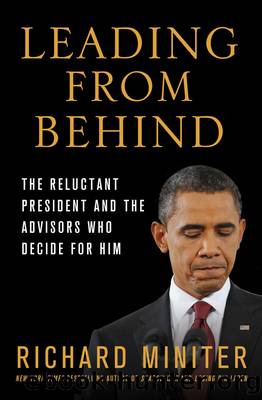
Author:Richard Miniter
Language: eng
Format: epub
Publisher: St. Martin's Press
CHAPTER 5
ISRAELâS DILEMMA
Youâre sick of him? I have to work with him every day.
âBarack Obama, talking about Israelâs prime minister Benjamin Netanyahu, with French president Nicolas Sarkozy1
Barack Obamaâs difficult chemistry with Israelâs prime minister Benjamin Netanyahu began years before they ever metâand the catalysts for that bubbling compound were two rabbis, one of whom the future president never met.
That admixture is so volatile that, people who have met both leaders fear, it is always about to explode. And, often, it did.
It raised the question that is the measure of any manager: Can he work with people of differing philosophies toward a shared goal? As we saw in chapter three, Obama had difficulty working with Republicans when a national debt crisis loomed. Netanyahu presented the same problem in a different way; Obama had to work with a skilled leader possessing a divergent outlook while the Arab Spring and the Iranian nuclear program threatened the future of Israel, the regionâs stability, and Americaâs oil prices.
Obamaâs challenge could hardly be greater. Israel is Americaâs most important ally in the worldâs most dangerous region.
Long before he was elected presidentâand long before he actually met NetanyahuâObama was signaling that he held a sharply different view of Israel compared to any of his postâWorld War II predecessors, either Democrat or Republican.
In the years before he was elected president, Obama developed rigid views about Israel while learning comparatively little about its complex history and present dangers. He had met the Palestinian activist and scholar Edward Said in 1982 and soon become close to him, Saidâs Columbia Universityâs archive had just been opened to researchers and reveals long, favoring letters to Said from Obama. They dined together, sent each other letters, made phone calls, and posed for photographs together over the next two decades. They were friends and Obama sought his approval. Rev. Jeremiah Wright and Rev. Jesse Jackson, both Obama mentors, also shaped his thinking on Israel. Once he was president, he did not modify his positions very much. So what did Obama think about Israel?
A little noticed speech in the middle of the country was the first clue.
* * *
In the heat of his fight with Hillary Clinton for the Democratic Party nomination in February 2008, Obama walked into a hotel ballroom in Cleveland to raise money without raising eyebrows. The crowd packed into the ballroom was mostly Jewish. Obama must have known that he would be asked about Israel. He knew he would have to be careful. The press, both mainstream and religious, missed the importance of Obamaâs words.
In his prepared remarks, Obama contrasted what he said was the open-mindedness of Israelis to discuss a broader spectrum of possibilities for peace, against the relative closed-mindedness of the American Jewish community: âOne of the things that struck me when I went to Israel was how much more open the debate was around these issues in Israel than they are sometimes here in the United States.â2
When Obama said these words, he had only been to Israel once, for a jaunt beginning on January 9, 2006.
Download
This site does not store any files on its server. We only index and link to content provided by other sites. Please contact the content providers to delete copyright contents if any and email us, we'll remove relevant links or contents immediately.
| Africa | Americas |
| Arctic & Antarctica | Asia |
| Australia & Oceania | Europe |
| Middle East | Russia |
| United States | World |
| Ancient Civilizations | Military |
| Historical Study & Educational Resources |
The Dawn of Everything by David Graeber & David Wengrow(1707)
The Bomber Mafia by Malcolm Gladwell(1623)
Facing the Mountain by Daniel James Brown(1553)
Submerged Prehistory by Benjamin Jonathan; & Clive Bonsall & Catriona Pickard & Anders Fischer(1455)
Wandering in Strange Lands by Morgan Jerkins(1430)
Tip Top by Bill James(1416)
Driving While Brown: Sheriff Joe Arpaio Versus the Latino Resistance by Terry Greene Sterling & Jude Joffe-Block(1376)
Red Roulette : An Insider's Story of Wealth, Power, Corruption, and Vengeance in Today's China (9781982156176) by Shum Desmond(1359)
Evil Geniuses: The Unmaking of America: A Recent History by Kurt Andersen(1354)
The Way of Fire and Ice: The Living Tradition of Norse Paganism by Ryan Smith(1336)
American Kompromat by Craig Unger(1315)
F*cking History by The Captain(1304)
It Was All a Lie by Stuart Stevens;(1300)
American Dreams by Unknown(1286)
Treasure Islands: Tax Havens and the Men who Stole the World by Nicholas Shaxson(1273)
Evil Geniuses by Kurt Andersen(1257)
White House Inc. by Dan Alexander(1212)
The First Conspiracy by Brad Meltzer & Josh Mensch(1174)
The Fifteen Biggest Lies about the Economy: And Everything Else the Right Doesn't Want You to Know about Taxes, Jobs, and Corporate America by Joshua Holland(1126)
